to Conclude His Penultimate Statements He Once Again Sheds Light
About a calendar week ago, Donald Trump was apparently feeling a fleck defensive after his praise for Vladimir Putin created some political troubles for him. It led him to release a ridiculous written argument in which he suggested he was responsible for rescuing NATO.
This is, as nosotros discussed shortly after, utterly bonkers: The but thing threatening NATO's existence was Trump himself, who not only repeatedly disparaged the alliance, just who, on several occasions, expressed an involvement in abandoning NATO altogether. Past all accounts, it was a plan he intended to follow through on in a second term.
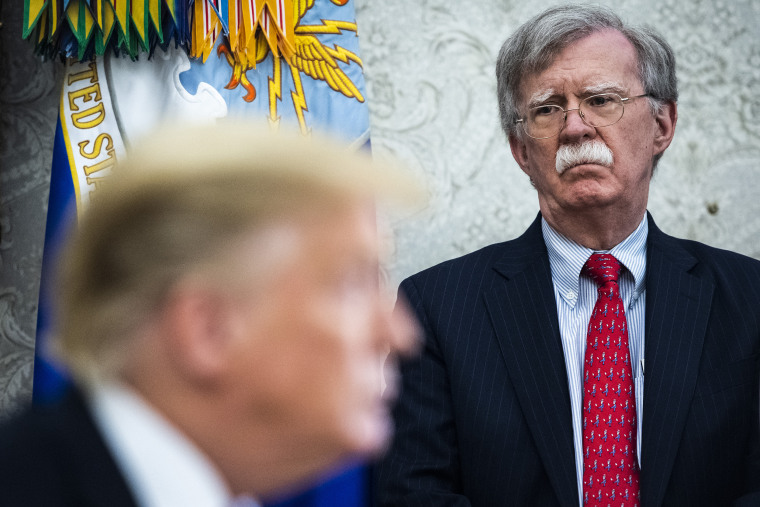
It was confronting this backdrop that John Bolton, who served as the White Firm national security adviser during the sometime president'south term, told The Washington Post late last week that he believes Trump would've withdrawn the United States from the NATO brotherhood in a second term. That wasn't a surprising observation, but accept annotation of its possible relevance:
"In a second Trump term, I think he may well have withdrawn from NATO," Bolton said. "And I think [Russian President Vladimir] Putin was waiting for that."
Let's accept a pace dorsum to consider how a quote like this one ties into the larger context.
For Trump and his allies, information technology's a point of peachy pride that Putin didn't invade any of his neighbors during the Republican's term in the White Business firm. The Russian leader launched offenses against bordering countries in 2008, 2014, and 2022, but betwixt Jan 2017 and January 2021, Putin showed restraint.
This, we've been told to believe, is clear proof of ... something.
The standard line from the right is built on two pillars. The first is the idea that Trump was so strong and unpredictable, the Russian authoritarian was simply too afraid to provoke the Republican. The 2d is the conventionalities that when the United States withdrew from Afghanistan, it signaled to Moscow that nosotros're weak and indifferent to international war machine offenses.
The former argument is and so plainly ridiculous, it'southward surprising Republicans would fifty-fifty peddle it. Trump spent four years going to about comical lengths to brand Putin happy, to the point that the then-American president'due south own director of national intelligence later admitted he feared Trump had been compromised by the Kremlin.
As for the Afghanistan claim — a favorite of a dandy many leading Republicans — it isn't much better. Putin's preoccupation with Ukraine goes back a lot farther than last summer. Indeed, in that location'south prove that Russia began building upwardly military forces around the Ukrainian edge months before U.South. forces left Kabul.
The idea that Putin would've altered his yearslong ambitions in Ukraine if just President Biden had agreed to keep thousands of American troops in Afghanistan is plainly at odds with everything we know near recent events. (What's more, if the right were serious most this line of rhetorical assail, it might lead to some awkward questions near the geopolitical effects of Trump's February 2020 agreement with the Taliban to cease the decades' long war. Did this bespeak weakness to Moscow?)
So, if the standard Republican explanation is unserious, what'southward the actual reason?
In a piece that generated an unusual amount of hate postal service, I recently fabricated the instance that Putin showed restraint during the Trump era because the Russian authoritarian saw no need to mess with a good thing. The basic idea — which I was glad to run into others endorse — is that Trump's actions were in line with Moscow'southward goals, and an invasion of Ukraine risked upsetting the balance.
Putin wanted to undermine the NATO alliance, and Trump undermined the NATO brotherhood. Putin wanted to weaken the East.U., and Trump made piddling effort to express his disdain for the E.U. Putin wanted to aid authoritarians, and Trump cozied up to authoritarians. Putin wanted to hurt Ukraine, and Trump launched an extortion scheme that threatened to hurt Ukraine. Putin wanted to weaken the U.S. political system, and Trump was unnervingly aggressive in trying to weaken the U.S. political system.
All of which is to say, why would Putin stone the gunkhole when Trump was already steering information technology in the Kremlin'south preferred direction?
Just Bolton has presented a related explanation that's quite credible: Putin saw an American president moving in a direction Moscow liked, and the Russian leader was waiting for Trump to finish the job.
Postscript: In case this isn't obvious, this should not exist seen as whatsoever kind of endorsement of Bolton's hyper-hawkish worldview, which I've been harshly critical of on many occasions over many years.
Rather, Bolton'southward perspective on stories like these matters precisely considering of his influential role on Team Trump.
Source: https://www.msnbc.com/rachel-maddow-show/maddowblog/bolton-sheds-light-putin-didnt-invade-ukraine-trump-rcna19045
0 Response to "to Conclude His Penultimate Statements He Once Again Sheds Light"
Post a Comment